1. Introduction
"There
are too many people killed for no reason.". Refugee man
from
While news about a forthcoming peace deal to end the 20 year-long civil war in
southern
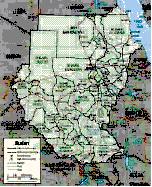
In February 2003, a new armed political group, calling itself the Sudan
Liberation Movement/Army (SLM/A) and composed mainly of members of settled
ethnic groups emerged and attacked government troops. While at first the local
authorities in
The majority of the casualties in the
In November 2003, Amnesty International delegates travelled to eastern
According to the information available to Amnesty International, the prime
responsibility for the grave human rights abuses committed against civilians
lies with the Sudanese government and militia aligned to it. The government has
bombed indiscriminately civilian towns and villages suspected of harbouring or
sympathizing with members of the armed opposition, unlawfully killing many
non-combatants. But the main perpetrators of violence against civilians and destruction
of civilian objects in
This report makes recommendations which can improve the situation in
Background:
Raids by nomad groups against villages in the rural areas of
In
Broadly-speaking, cultural and ethnic differences between communities, which
seem to be more and more manipulated in the current conflict, are fluid. The
vast majority of the people in
In
The
There is no doubt that the arming of militia from the Miseriya and Rizeiqat
groups, since 1986 by the former Sudanese government of Sadiq al-Mahdi and
pursued by the government of Omar Hassan al-Bashir since 1989, to counter the
rebellion in southern Sudan has also contributed to the increasing insecurity
in Darfur. These militia, called murahilin,
appeared to have been given a free rein to raid villages suspected of
supporting the southern rebellion, abducting people and looting cattle and
goods as a reward. Many of those abducted in the region of Northern Bahr
al-Ghazal have subsequently been used as domestic workers, field labourers or
cattle herders, often for no pay and in slavery-like conditions(5).
In 2001, the
In January 2003, Amnesty International delegates visited
The so-called deterrent effect of the Special Courts in
In January 2003, Amnesty International called on the government to resolve the
deteriorating situation by respecting human rights and by bringing leaders of
different ethnic groups into discussions. In February, it also called on the
Sudanese government to establish an independent and impartial Commission of
Inquiry into the complex causes for the violence and human rights abuses in
Between June and August 2003, attacks against civilians and displacement
increased as well as harassment and arrests of internally displaced persons. Tina(7), which was taken by the
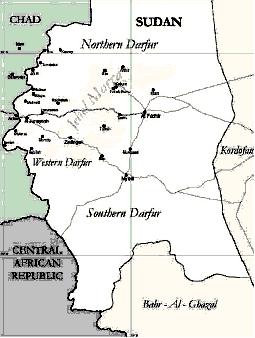
Map of
In September 2003, the Chadian government, neighbour to
In December, the talks between the
Since the collapse of the talks, fighting between government troops and the
armed opposition has intensified, reportedly in Abu Gamra and Kulbus between
December and January. So have further reports of deliberate and deadly attacks
on civilians, including in
Responses by the Sudanese government to the deteriorating situation in
At first, the
Amnesty International is further alarmed at the extent of the killings amongst
the civilian population, and the failure of the Sudanese government to make
accountable the militia and its own soldiers who are killing in the name of
"counter-insurgency". This can only increase among the population
feelings of desperation, and the desire to take revenge for deaths of
relatives, and possibly the joining of the armed opposition as the only
perceived available option. The restrictions on freedom of expression, assembly
and association in
The grave human rights abuses described in this report represent only a part of
what is happening in
2. Grave abuses of human rights and humanitarian law in
2.1 Grave abuses by government forces and government-aligned militia
2.1.1 extrajudicial executions and other
unlawful killings
Extra-judicial executions and unlawful killings of civilians in ground
attacks
Amnesty International obtained numerous testimonies of attacks on villages and
killings of civilians being carried out either by the Janjawid, or by the
Janjawid accompanied and supported by Sudanese government soldiers(11).
In some cases, the soldiers would stay behind the Janjawid, cordoning the
village and preventing people from fleeing. In other cases they would
participate directly in attacks against civilians. The nature of the killings
committed by government soldiers, and those committed by the Janjawid in the
presence of elements of the Sudanese army indicates that they were
extra-judicial executions. In other circumstances when the presence of soldiers
in the attacks is not reported, killings by the government-aligned militia
represent at least unlawful and summary killings, a grave violation of
humanitarian law to which all armed groups in internal conflicts are bound.
Typically, attacks on villages in rural areas or towns consist of the Janjawid,
also called "Arab" militia, sometimes with government soldiers,
surrounding the village, either at dawn or during the day, and surprising
villagers who do not have the time to flee or defend themselves. Sometimes the
attacks appear to be well planned in advance, and happen at market days, or
during or after the prayer at the mosque, while people are gathered. Many
villagers have also been killed in their houses.
Erkuri Mohamed, aged 34, Koranic student, from the
« The Arabs and the soldiers arrived on market day in Abu Jidad (a
nearby village). The soldiers cordoned the market and the Arabs got inside to
take the money and the cattle. They killed several persons. I saw the bodies of
those killed. Some were killed by the gun, others by bayonet. » He gave AI the
names of 19 persons killed.
Kaltuma Abdallah Issa, f, aged 15, from Abu Jidad near Kutum said : « I was with my father when the Arabs suddenly
arrived in the village, at around
Nur Ibrahim Aran, a chief in the Abu Jidad area, reported that
Abu Jidad was attacked on
Kutum, in
« The Janjawid came in the morning, broke the shops and took the money, the
sugar, and the goods. They killed 32 people in their houses. They came in the
houses to find the boys and men and kill them. They also killed Ahmed Issa, my
brother, a shopkeeper, aged 18 in the market. They cut the fruit trees in my
garden to give to their camels. "
Dahbai Mohamed Adam, aged 38, from Abu Gamra, a village near Kornoy
explained that the Arabs came to steal in the village and burn the houses while
the men were away.
« My daughter's husband had stayed. He was sleeping in his house,
they awoke him and beat him to death with a stick and a gun. »
Aisha Ali, f, aged 23 from the
"The Arabs arrived and asked me to leave the place. They beat women and
small children. They killed a little girl, Sara Bishara. She was two years old.
She was knifed in her back."
Zeinab Nayah, aged 25, from Nana, a village near Kornoy saw her brother
being killed in his shop by members of the Janjawid in August. She stated that
he was beaten before being killed. Gorsella village, near Kornoy, was
attacked at
On a Sunday in July 2003, at about
"They tied his feet and hands and slit his throat in front of people. The
Arabs were dressed in military uniforms, they had
weapons, guns, horses and camels. My son did not have any weapons."
Tina was the scene of severe fighting between government forces and
armed opposition groups several times in 2003. Zenaib Ahmed, aged
30 described an attack on Tina in July: « It was on a Friday, in July. There
was a fight between the rebels and the Janjawid supported by government forces.
I was going out for the prayer when I received shrapnel on my left shoulder and
on the bottom. My brother was there to carry me to the hospital in town. I know
certain people like Zeidan Omer and Adam Mohamed who were executed. When I was
at the hospital the Arabs came in but they were looking for the men, not the
women. »
In August 2003, the
Many villages around Silaya, a town under government control, where the
Janjawid are said to be based, were attacked in July and August 2003. The
Around the same time, Amir, a village near Jafal of about 350 people,
was attacked. One of the villagers testified : « The
day of the attack was the 7 July, a Saturday. They came. They were more than
200 and had 10 vehicles. There were soldiers from the army amongst them. We
were surprised by the attack, because it was
On 16 August, Garadai, another village in the area was attacked by the
Janjawid, during the day. One of the villagers told Amnesty International delegates :
« It is the Janjawid who burnt our houses and stole our cattle and belongings. Cattle stealing has been happening for a long time but the
burning of houses is recent. They came with camels, horses and a lot of
weapons. They are composed of Arabs from the area and other Arabs. They
attacked women, men and children even though they did not have weapons. I would
say that at least 240 people were killed during the attack. This is more than
half of the population of Garadai, which counts 400 inhabitants. They killed
mainly the young men, although some old disabled persons were killed because
they were not able to get out of their houses in time.»
While the attacks target mainly people from the Zaghawa, Masalit, Jebel or Fur
or smaller farming groups, sometimes Arab groups have been targeted, apparently
because they refused to take sides in the conflict. At the end of July 2003, a
group of Dorok, an Arab community living around Silaya, came under the
attack of the Janjawid. Ahmed Issa Adam, aged 30, from Abu Jidad
village, told AI delegates :
« The Arab militia came to our village to invite the Dorok to join them. The
Dorok refused and said that they shared the same religion with the people of
the region and that therefore they could not fight their neighbours. So the
Arab militia considered the Dorok as « Blacks » and shot at them. » The persons
he reported were killed include : Adam Mahmoud Ali, farmer, aged 35 ; Fadl
Abdel Aziz, herder, aged 58 ; Atiya Ibrahim Abdallah, herder, aged 27 ; and
also Matur Abdallah, 45 ; Bahar Ahmat, 40 ; Idris Abdallah, 70 ; Adam Mohamad,
55 ; and Mohamad Abdallah, 35.
In Birak, Amnesty International delegates met two brothers from Jizu,
three hours' walk from Silaya, who had been wounded by gunshots during an
attack in July. Their village was attacked on a Monday, market day, by the Arab
militias, who killed 5 persons. They also met Zaghawa people from the
Amnesty International delegates visited several sites around Adre in
The
"It was early in the morning, people were sleeping. About 400 armed people
cordoned the village, with military uniforms, the same ones worn by the army,
with vehicles and guns. A plane came later, to see if the operation was
successful. At least 82 people were killed during the first attack. Some were
shot and others, such as children and elderly, were burnt alive in their
houses."
Another, who had a wound on his foot, said: "I stayed in the village after
the first attack. Then another group attacked again on market day, at around
In Meramta, a village of about 450 households, approximately 25 km south
of Al-Jeneina, more than 300 persons were reported to be killed, mostly shot,
in an attack at dawn by the Janjawid and government soldiers on 28 July. Women
trying to flee were beaten with gun butts. Houses were subsequently burnt down.
Meramta was reportedly attacked at least four times. In an attack in October,
at mid-day, ten more persons were killed and five wounded. The village is
reportedly now empty. Tukultukul a village near Meramta was attacked on 28
July, the same day, two hours later, at
Attacks on villages, such as Dongajul, Seratiya, Kulkute, Guinda, Haraza
around Al- Jeneina reportedly continued in November, prompting more civilians
to take refuge in
Kasia village was attacked three times between the 28 and
Bauda, some 80 km south of Al-Jeneina, populated by some 200 households,
was attacked on 29 August, at
Sometimes those attacked know their attackers. On 10 August, Suani, a village
around Al-Jeneina, and its market, were attacked in the afternoon by the
Janjawid mixed with soldiers. "We know the Janjawid", one villager
told AI delegates, "they were our neighbours
before, the Rizeiqat and the Mahariya." They killed nine men who were
running away, beat up the women and looted all the cooking pots. They did not
burn the place.
While many of the killings appear to have specifically targeted men, sometimes women
and even children have also been deliberately killed. In Abu Gamra,
in September, a child, Khadija Idris, aged 17 (f) was killed by the militia
when she tried to stop them stealing her cattle. In Murli, near
Al-Jeneina, at least nine women were reportedly shot dead during an attack by
the Janjawid. They include: Alima Adam, 25, Kaltuma Sabu, 25, Awa
Abdallahi, 30, Mariam Harun, 35, Khadija Abdullahi, 30, Fatuma Idris, 20, Aisha
Mohamed, 30, Nafisa Adam, 40, and Dolma Ismail, 20.
Sometimes isolated people were killed while in their fields, or on roads.
Al Mahdi Suleiman, 30, Hassan Suleiman, 20 and Dilloh Ismail, 30, from Hasan
Basau, a village in North Darfur, were reportedly attacked and killed by Arab
militia while taking their cattle to grazing areas sometime in April. One other
person, Arbab Ibrahim's stepfather, was killed by Arabs on his way back from
the market to his village Mejde in the Habiela region in June.
Amnesty International delegates collected many other testimonies from the
refugees which were consistent with each other. They indicated a clear pattern
of repeated violations both by the Janjawid and government soldiers. Many
testimonies consistently suggested that the Janjawid and the soldiers were
co-operating.
Unlawful killings due to deliberate or indiscriminate bombings
Ground attacks on villages and towns were often preceded or followed by
bombings by the Sudanese air force. According to the testimonies of the
Sudanese refugees in
Most bombings, as described to Amnesty International by eye-witnesses, appeared
to have disregarded the requirement to distinguish between civilian persons and
objects, and military objectives or the principle of proportionality. Both are
cornerstones of international humanitarian law regulating armed conflicts. In
some instances, the bombings would appear to have deliberately targeted
civilians and civilian objects.
Bombings usually consist of boxes filled with metal shrapnel dropped from the
back of Antonov planes. By their nature these lack precision. Sometimes
civilians have reported the presence of helicopter gunships, flying at low
altitude and shelling villages and civilians. These two types of aircraft have
repeatedly been used by the Sudanese government in the conflict in southern
Bombings have had the effect of terrorizing the population and encouraging
panic and displacement. Most civilians who have taken refuge in
Kornoy was repeatedly bombed since June 2003, provoking the population
to flee en masse to
Tina was repeatedly bombed as part of government attempts to crush the
armed opposition, who had taken control of the city, killing civilians. Faiza
Idris Adam, a female pupil aged 14, testified: "It was
« The plane came and the fire coming from the bombings cut my fingers. Now the
blood sometimes comes out between my fingers, it still hurts. I am a school boy
in fourth class, I used to write with my right hand. »
When his mother attempted to take him to hospital, the plane came back. They
both fled to Tina Chad.
Most villages around Tina were also bombed. Khasan Abu Gamra was bombed
so many times that its villagers said : « The planes
bomb anytime and everywhere, sometimes four times a day, in the morning, in the
evening. They bomb so much that we can't go to cultivate our fields. Many
people and animals were killed because of the bombings. » In Tumdubai,
about four hours walk away from Tina, bombings also occurred several times a
day. Khasan Basao was also hit by bombings.
Kutum was bombed during the fighting between government troops and the
Villages around Silaya further south in
2.1.2 acts of violence and torture, including
rape, against civilians
Ground attacks and the killing of civilians by government and
government-aligned militia were often accompanied by brutal acts of violence,
including shootings and beatings, and sometimes rape of women and girls. Many
villagers reported that the primary targets for killings appeared to be men. While
women were shot dead in certain occasions, it seems that the majority of women
were beaten rather than killed during attacks.
During an attack in Kornoy, Jamal Adam Nusur, 20 years-old, was pursued
and allegedly beaten so badly by the Janjawid that he subsequently died of his
wounds.
Kaltuma Abdallah, 15, was reportedly directly attacked by Arab militia in Abu
Jidad. She was in her house when they arived. She fled and was shot by a
gun. Her aunt was shot dead.
Adam Mohamed, aged 40, and his brother, from the Tama ethnic group, were
attacked on 14 November in their village Tutursa. Adam Mohamed was taken
by surprise in his house by a number of militia members. They flogged him while
saying "You are all opponents, we will eliminate you." They took all
his money. He managed to escape and walked to
When Murli was attacked, Jamila Mohamed, a woman, reportedly fled on
foot with another woman, Aisha Harun. The attackers pursued them on horseback.
They stopped them, beat them with dry bush branches and took her clothes. Then
they let them go. In Tuja, a village near Murli, Hawauu Hasan Tuja, a
woman, was fleeing an attack by Arab militia, with her seven children. The
children managed to escape but she reported that she was beaten and robbed of
her clothes and belongings.
In some instances, women found on roads or in the bush while collecting wood,
travelling or fleeing attacks were raped.
Amnesty International delegates heard accounts of rape of women and girls by
the Janjawid. It is difficult, however, to know the extent to which rape is a
practice in the conduct of the war in
As women put it to Amnesty International delegates:
"Women will not tell you easily if such a thing happens to them. In
our culture, it is a shame, and women will hide this in their hearts so that
the men do not hear about it."
"Women will not tell you spontaneously if they were raped, it is a hidden
shame. However, if you are asking, some women will tell you. The women have
rights too and we are happy if someone is concerned about this."
In Sasa, near Kornoy, two girls(12),
respectively aged 15 and 14, were reportedly raped by Arab militia, according
to a woman interviewed by Amnesty International delegates in Tina.
In Murli, three girls, aged 10, 15 and 17, who had fled the attack were
found by the attackers in the bush and reportedly raped. The girls are said to
still be in
A man from Suani said: "A lot of women were beaten during the attack,
with sticks and gun butts. Some of them were wounded and went to the hospital
in Al-Jeneina. But you need money to go to the hospital. There are also ten
women in our village who were used by force as wives by the Arabs."
2.1.3 destruction of villages, crops and
looting of cattle and property
Ground
attacks seemed not only to aim at killing the people, but also their
livelihoods and their very means of subsistence. In a region prone to drought
and underdevelopment, the destruction of houses and crops bears terrible
consequences on the coping strategies of the local population. It means that
shelter and food, essential commodities and also economic and social rights are
being denied to the population. The displacement triggered by direct attacks on
civilian villages is also adding pressure on the populations of towns in
The testimonies of eye-witnesses to the destruction happening in
People in the rural areas of
Moreover, citing insecurity and the necessity of counter-insurgency, the
Sudanese government has restricted the movements of people in
The people of Turlili explained how destruction and looting affected
them:
"First the Arabs burnt the houses and took our animals. Then they took our
cooking items, our millet in the fields and even our blankets. This is what
made us come here. They took the millet with them, we
could not harvest our crops. Their camels ate our crops too. Usually we harvest
in September and women cultivate vegetables after the harvest. How are we
expected to live now?"
A local chief in the Abu Gamra area, between Tina and Kornoy, painted
the extent of the destruction in his village :
« The Arabs and the government forces arrived on both sides of the village,
with vehicles, on horseback and on camels, and armed with big weapons. I hid in
order to see how many they were. The Arabs cordoned the village with more than
1,000 horses. There was also a helicopter and an Antonov plane. They shelled
the town with more than 200 shells. We counted 119 persons who were killed by
the shelling. Then the Arabs burnt all our houses, took all the goods from the
market. A bulldozer destroyed houses. Cars belonging to the merchants were
burnt and generators were stolen. They said they wanted to conquer the whole
territory and that the Blacks did not have a right to remain in the region. »
Other villagers from around Tina said that the bombings had destroyed water
wells. In Khasan Basao they alleged that some water wells were poisoned
and smelt of sulphur. They also alleged that landmines were planted around the
village.
2.1.4 abductions, arrests, torture and killing
of detainees
Ground attacks by the Janjawid have sometimes been followed by abductions of
civilians. There is no information as to the whereabouts or the treatment of
the following abducted persons. Amnesty International is concerned that these
individuals may have "disappeared".
Two women from the
Three men of the Dorok ethnic group were said to have been abducted by the
Janjawid after the attack on the
The mayor Abu Gamra, Kitir Mohamed Adam, told AI delegates of the
abductions of two girls by the Janjawid during the attack on Abu Gamra, on
market day.
« This man was shot as he was trying to flee the militia on his horse. His
daughter and another woman were also fleeing but one saw her father being shot
and came back to help him. The father gave a gun that he had to his daughter so
that the two women could defend themselves. The Arabs took the gun from the
women, hit them and forced them to mount on their horses. They took them away.
Their names are Hawa Abdel Rahman Kitir, 28 years-old and Fatima Ahmed Issa, 32
years-old. »
In Garadai, near Silaya, the abduction of some thirty men by the
Janjawid was reported.
The villagers in Garadai have not had any news of them since
: « We do not know why they took them. Maybe to kill
them or to obtain information from them. » Their names were given as:
- Abdallah Adam, 40, trader
- Abdallah Abaker, trader, 42
- Musa Isa, farmer, 30
- Ahmed Ishaq, farmer, 37
- Abdallah Ahmed Ibrahim, farmer, 40
- Mohamed Ibrahim Adam, 50, farmer
- Dini Mohamed, 35, farmer
- Yahya Izrik, 45, farmer
- Mohamed Abu Adam, 25, farmer
- Adam Abdu, 45, farmer
- Musa Yaqub, 45, farmer
- Mohamed Abaker, 60, farmer
In Jizu, near Silaya, some 12 persons, all farmers, were also abducted
after an attack. They were reportedly tied up and made to walk in front of the
Janjawid's horses. Their names were given as :
- Abdallah Ali, 35
- Jir Abdallah, 25
- Bashir Suleiman, 27
- Yahya Abdel Rahman, 25
- Abakar Issa, 25
- Mamad Khalil, 45
- Mohamed Suleiman, 45
- Abdallahi Abdallah, 45
- Anwar Ibrahim, 50 ans
- Taher Ahmed Mohamed, 25
- Bishara Abdallah, 35
- Din Ibrahim, 25
In Turlili, north of Silaya, twelve persons were reportedly abducted,
including Abaker Adam Omar, aged 40 and Abdel Aziz Hassan, aged
27.
Idris Suleiman, 30, was reportedly abducted by the Janjawid along with other
persons in Usha village, south of Silaya. The other persons abducted
were named as:
Mohamed Suleiman, 50, trader
Mohamed Dein, 40, trader
- Adam Abo, 60, trader
- Yahya Issa, 35, farmer
- Yahya Omar, 36, farmer
Bahar
Amer
- Abdel Karim Yaqub
- Dahab Mohamed
- Mohamed Nigui
- And three women whose names are not known
Amnesty International delegates were told
of another group of 22 persons who were abducted by the Janjawid at Suani
market, near Al-Jeneina and tortured. One of them, Arabi Anjol was summarily
killed in what appears to have been a deliberate execution. Amnesty
International fears that other persons abducted named in this report may have
suffered the same fate.
Two men who were amongst the 22 abducted
and who managed to escape, told Amnesty International delegates their ordeal :
« On 12 August, the Arabs cordoned off the market. They wanted to take revenge
so they did this to us. At first people started to flee and the Arabs said that
they would not do us any harm. So we stopped fleeing. They chose certain people
randomly and tied them up in the middle of the market, in front of everyone. They
forced us to crouch with rocks behind our knees. They left us under the sun and
started beating us. One of us, Arabi Anjol had his arm broken because of this.
« When the sun set, they forced us to go with them, by running in front of
their horses. They took us to their military camp where there were soldiers and
a building with canons inside. The camp is headed by someone from the Sudanese
army and another one. They left us outside and beat us with rocks and gunbutts.
They were saying « We are the Arabs, we have the priority, you are the blacks
»; « the government gives us weapons and you can't stay in
« There are five people who still suffer from the torture, including one who
was beaten in the eye, we think that they are in
Al-Jeneina hospital. The others are still in Al-Jeneina with their families. We
heard that there is an accusation pending against them; they will be tried by
the authorities, we do not know why. »
Government regular forces, including the
army, the military intelligence and the security forces have carried out
numerous arrests in
The Sudanese refugees met in
In Kutum, the arrests of people were reported before fighting took place
between government troops and armed opposition groups at the end of July. Al-Hadi
Adam was allegedly arrested by the government and has not been heard of since.
Around Silaya, other persons were arrested in the months that preceded
fighting. They include Adam Abdallah, who was reportedly chained and beaten
upon arrest ; Abaker Adum, a 37 years-old farmer, who was arrested on the road
to Silaya and Ismail Yahya, a 40 years-old farmer who was arrested on the road
to Silaya in July. Their friends have not heard from them since. They suggested
that they may be held in A-Jeneina prison. A trader, Ishaq Abdallah, was also
arrested in June 2003 in Kongok village, North East of Al-Jeneina, after the
Arabs reportedly complained to the government that he was revealing their
secrets. He has not been seen since.
As part of the September cease-fire sponsored by the Chadian authorities, the
government and the
- Mohammad Adam Musa (said to have had a broken leg)
- Abaker Tikki Jamus
- Mustafa al-Tom Hari
- Saleh Omar Shaikh al-Din
- Ibrahim Khater Arja
- Al-Damarja Hamed
- Hamed Bijja Ambedda
- Al-Sadeq Ali Abdallah
- Mohammad Jiddu Karkur
- Abdel Majed Hamed
- Ibrahim Jaber Musa
- Yaqub Yunus Har
- Ahmad Issa Nahar
- Ibrahim Ahmad Ismail
- Abdel Rahman Sharif Ali
- Suleiman Ismail Omar
- Khater Ismail Abdallah
- Tukar Ahmad Yaqub
- Yahya Bashir Bush
- Omar Musa Ibrahim
- Ahmad Yaqub Mohammad
- Hassan Baqeira Arba
- Bashir Ali Aqid
- Mukhtar Ishaq Saleh
- Musa [last name unknown]
2.2 Human rights abuses by armed political groups
2.2.1 Reported unlawful killings and looting
The UN information network IRIN reported on 30 July that "
On 2 January 2004, "the armed opposition reportedly attacked the village of
Sharaya in Southern Darfur on 2 January, killing between four and six policemen
and soldiers, and looting a local market.", according to IRIN. The
Governor of West Darfur was quoted as saying that "there were no army
troops in the vicinity and the few police and security men were taken by
surprise and were unprepared for such an engagement with such a big gang of
heavily armed outlaws."(15)
Amnesty International has received very little information regarding killings
of civilians by the armed opposition the
2.2.2 Arrests and detention by armed opposition groups
Amnesty International sought information with the Sudanese authorities about
the number of government soldiers detained and released by the armed opposition
and their treatment while detained by the
Amnesty International received information that six persons(16)
were arrested and tortured by the Justice and Equality Movement (JEM). On 18
September, armed members of the JEM circled the house where six men were
staying in Jirjira, south of Tina,
3. The responsibility of the Sudanese authorities in the grave human
rights violations committed in
The numerous and concordant testimonies of the Sudanese refugees in Darfur, as
well as other information collected by Amnesty International on the human
rights situation in Darfur, clearly point at the responsibility of the Sudanese
government in deadly attacks against civilians. Bombings on civilians and
civilian objects are conducted by the Sudanese Airforce. Moreover, many
eye-witnesses to ground attacks on villages in
Even if some government officials have denied any links between the government
and the Janjawid, there is a large amount of information which shows that at
least certain elements of the Sudanese army in
Moreover, the Sudanese government has not condemned or conducted transparent
and impartial investigations into the numerous and grave human rights abuses
committed in Darfur and reported by local civil society activists, community
leaders, journalists and non-governmental organisations. Amnesty International
thinks that by its silence, the Sudanese government is condoning or encouraging
more abuses. The impunity with which the Janjawid militia have acted in
Amnesty International believes that there is clear evidence of co-operation
between the Janjawid and the government forces; the government should either
cease its support for the Janjawid or it should establish clear chain of
command control over them and make them accountable for the grave human rights
abuses they have perpetrated. Either way the government should take appropriate
steps regarding all reported abuses of human rights or humanitarian law,
whether committed by the Janjawid, by other government-aligned militia, by
government forces, or by different forces in co-operation with each other. All
such reports should be promptly and independently investigated and perpetrators
brought to justice.
3.1 Bombings and attacks by government armed forces
Antonov planes and helicopter gunships are the property of the Sudanese
army. In this document, Amnesty International has described numerous examples
of indiscriminate or direct bombings of civilians. There are many more cases of
bombings which are not given in this report but which have been reported by
different observers or civil society groups following the situation in
Even more compelling are the consistent testimonies of countless civilians
attacked, in different parts of
3.2 Information showing links between the Janjawid or "Arab"
militias and the government
As said earlier, the conflict seems to
take on a racial tone. The armed political groups claim that the
"Blacks" have been discriminated against by the government. The
rhetoric used by the Janjawid as reported by civilians they have attacked shows
that they believe that they act as counter-insurgency armed forces in the
A refugee farmer from the
A civilian from Jafal confirmed this when he was reportedly told by the
Janjawid: "You are opponents to the regime, we must crush you. As you are
Black, you are like slaves. Then all the
Other information given by victims of the conflict shows that
the military actions of the Janjawid are well-organised, and many times
coordinated with elements of the Sudanese government army. Several
persons of the same village told Amnesty International delegates:
"The chief of the Arabs...gives auxiliaries to the army....the high
commander of the Janjaweed...is based in Al Geneina. There is a military camp
called Guedera where they train people. It is not a secret. They get organised
in Al Geneina and then the planes go to this camp. "
A villager from Meramta, near Al-Jeneina explained :
« Here the plane does not bomb us. It gives the Janjawid ammunitions, weapons
and food. They have camps where they meet: Guedera and Dedengita, about 25 km
away from the village. These camps have existed for 4 months, before there was
nothing. Helicopters also come to supply them. »
Several sources have pointed at the presence of leaders of the Janjawid in
Al-Jeneina, the capital of
All the victims of attacks described the
Janjawid as being well-armed and well-equiped. They are in majority dressed in
military uniforms and are often accompanied by soldiers driving military
vehicles. The types of weapons described by the refugees are
: kalashnikovs, bazookas, rifle guns such as the G3 or the Belgian FAL. Amnesty
International is concerned at the level of armament of these irregular troops.
After the
On another occasion, Humanitarian Aid Commissioner, Dr Salaf El Din, seemed to
confirm that the government had called on
3.3 Failure of the authorities to condemn or investigate abuses
According to the information available to Amnesty International, the
government has not, except in three occasions, condemned attacks against
civilians and grave human rights violations which have been committed by their
soldiers or the Sudanese Air Force during the conflict. The silence of the
authorities regarding the atrocities committed by the Janjawid suggests that
their actions are condoned, if not encouraged, by the government. Persons who speak
out against human rights abuses in
Only twice the government announced that investigations would be held into
particular reported cases of killings.
The level of the atrocities committed in Kutum, in particular the summary and
targeted killings of well-known merchants by the Janjawid, provoked outrage in
In Habila,
A statement by the Embassy of the Republic of the
4. A looming humanitarian crisis
The number of civilians affected by the conflict is not limited to those killed
or wounded by the attacks. Those who have survived attacks and fled face more
abuses of their rights to adequate protection and humanitarian assistance. The
level of insecurity in the region, the remoteness of areas in
4.1 The situation of the Sudanese refugees in
4.1.1 continuous insecurity for those seeking
safe haven
Civilians fleeing to
Civilians met by AI delegates reported how dangerous their journey to
Sarfa Adam, from Basao said :
« My sister's children had animals; they took the animals to
Ahmad Suleiman, 30, his brother, Hassan Suleiman, 20, and Dilo Ismail, 30. »
Osman Yahya Kitir, from Garadai said :
« Some of us came here, others fled to Silaya town in
A handicapped Sudanese refugee who fled an attack on his village in
Some of the civilians who have fled to
Refugees in Kolkol, near Adre, said to Amnesty International delegates : « The Arabs attacked us in
UNHCR has reported several cross-border attacks of the same type. (19)
Moreover, on
Tina on the border with
4.1.2 Critical humanitarian conditions for the Sudanese refugees in
While the Sudanese refugees in
Although the refugees were welcomed by the local population, who have shared
their limited means of subsistence with them for more than seven months at the
time of writing, most of them still live in precarious conditions. Amnesty
International delegates visited eight locations where refugees were living : Tina 1, Tina 2, Birak, and Adre, Birkengi,
Nakuluta, Kolkol and Agan. In Tina 1, the refugees were living in huts made out
of fabrics and sticks found in the area. In other locations, they were living
in precarious shelters made out of dry branches they could find in this
semi-desert region.
At the time of Amnesty International's field mission in November 2003, relief
was distributed by UNHCR only to the most vulnerable and geographically
accessible refugee populations. Many suffered from hunger and thirst. Amnesty
International delegates saw how refugees had to dig deep in the sand to find
water, which was muddy. Many refugees arrived in
Many refugees have also highlighted the difficulties faced by their children,
most importantly the lack of education facilities.
In Tina 2, the refugees showed Amnesty International delegates a large hut that
they built for the schooling of their children. They were worried that the
children had been out of school for months because of the conflict in
The UNHCR has been hampered in its relief efforts by the poor infrastructure
and the sheer number of refugees. In mid-January 2004, the agency started the
relocation of Sudanese refugees in sites far enough from the insecure border,
in line with international refugee law standards(21),
along with a proper process of registration of individuals. Two camps have been
built, Farchana, 55 kilometres away from the border town of Adre, which could
welcome between 10 and 12,000 refugees, and Saranh, in the Iriba area, north of
Tina, with a capacity of up to 20,000 people, and Kounoungo, near Guereda,
which could host 8,000 people(22). Other sites will need to be identified and
equipped to host more than 100,000 refugees and provide adequate protection and
assistance to those who have arrived in the past few days.
Relocation to sites 50 kilometres away from the border is essential for the
security of the refugees. Amnesty International believes that the international
community must make an urgent and massive effort to complete the relocation of
all the refugees before the start of the next rainy season in May 2004.The
reported difficulty in finding sites in Chad which have water, the logistical
obstacles due to the remoteness of the area and the continuous influx and the
sheer number of the refugees have to be overcome to save further lives.
4.2 Denial of protection and assistance to the displaced in
Within
Those who have sought refuge in towns in
Scores of civilians fled to Kabkabiya town between June and August 2003.
Reports alleged that 300 villages had been attacked or burnt to the ground in
the area. Many displaced were reportedly living in the open or in the local
school in Kabkabiya, having very little or no access to humanitarian aid. For
instance hundreds had fled after an attack on Shoba,
a Fur village situated 7 km south of Kabkabiya on 25 July, by armed militia
wearing government army uniforms, in which at least 51 Shoba villagers,
including many elders, were killed. They were reportedly prevented for two days
from returning to Shoba, to assist the injured and bury their dead, by a road
block organized by government soldiers. In December 2003, internaly displaced
persons camps around Kabkabiya were reportedly attacked by the Janjawid.
Thousands of civilians fled Kutum at the beginning of August 2003 and took
refuge in surrounding villages or unknown places or tried to reach El-Fasher,
the capital of North Darfur, situated some 80 km south-east of their town. Although
a few were said to have reached El-Fasher, most were reportedly stranded in
Kafut, a village halfway between both towns, because the Sudanese army stopped
more civilians from taking refuge in El-Fasher. Civilians were reportedly
living under trees, without any means of subsistence and were in desperate need
of food, shelter and clothing, until a preliminary assessment of their
conditions was allowed by the Governor of North Darfur.
Between the end of September and the beginning of October 2003, some 24
villages inhabited by the Dajo around Nyala were reportedly attacked and burnt.
Amnesty International was given the names of at least 42 persons killed and 20
others wounded in these attacks. Some 3000 persons were said to have fled
closer to Nyala town in places called Diraige and Al Nil. The local authorities
allegedly put as a condition for assistance to them that they return back to
their villages, even though these had been burnt and were located in insecure
areas prone to attacks.
Amnesty International also received allegations that persons displaced from
villages attacked around Kutum were forced by the local authorities to pretend
that they were living in the houses of people who had fled Kutum town at the
time when a USAID official visited the town in October 2003.
Aid agencies in
Nine Sudanese workers transporting food aid by truck were reportedly killed in
October in an attack by an unidentified armed group(23).
Four Sudanese workers for Medair, an international relief organisation and a
government official were abducted around 11 November while they were reportedly
distributing kits for displaced people around Silaya and Kulbus, in western
The media have reported that despite the government promising access to
humanitarian agencies, these are denied travel permits before going to the
area.(25)
Unimpeded and secure access to internally displaced persons by aid
organisations is crucial to avert a humanitarian crisis. As the ceasefire talks
collapsed in December and fighting was renewed on a
large-scale, UN relief agencies left Al-Jeneina, the capital of
On 2 January, several thousands displaced persons living around Mornay town
were allegedly attacked by the Janjawid and government soldiers. The displaced
reportedly left Mornay to Al-Jeneina, some 85 kilometres away. Other villages
and towns in the area of Al-Jeneina were reportedly attacked in the same
period, including Mestero, Beida, Habila. Al-Jeneina
is reportedly surrounded by military outposts, and those newly displaced are
allegedly not allowed to enter the city.
On 15 January, the local authorities in Nyala reportedly closed camps where
persons internally displaced by the conflict were living around the town, after
attempting to forcibly move them to other camps situated some 20 kilometres
away from the town(26). These other camps are reported
to be situated in areas unsafe because of the ongoing fighting and this would
be the reason why the displaced did not want to be relocated there, fearing for
their own safety. Moreover, these new camps are reported to be less accessible
to humanitarian agencies present in Nyala and to be ill-equiped in water, food,
shelter and latrines to host people. The forcible relocation of displaced
people contravenes the provisions of international humanitarian law.
The UN is advocating a humanitarian ceasefire agreement for
5. International human rights and humanitarian law
International human rights law considers extrajudicial executions and other
unlawful killings to be gross violations of human rights.
International humanitarian law, which includes the Geneva Conventions of 1949
to which
Parties to an armed conflict are bound to respect international humanitarian
law. They will be responsible for violations of this law by their own armed
forces. In particular, armed political groups and militia are bound to respect
international humanitarian law. Governments' regular armed forces are bound to
respect both international human rights and humanitarian law. Moreover, States
will also be responsible for violations of international human rights and
humanitarian law by other forces that are under their control and authority.
Customary international law codified in Article 13 (2) of the Additional
Protocol II to the Geneva Conventions (15) generally provides that the civilian
population as well as individual civilians shall enjoy protection against the
dangers arising from military operations. It prohibits making civilians as such
the object of direct attacks, and acts or threats of violence; the primary
purpose of which is to spread terror among the civilian population. In
addition, Article 13, by inference, protects civilians from indiscriminate or
disproportionate attacks. (16) Civilian status is lost only where the person
takes an active part in hostilities, not merely on the basis of support or
affiliation.
The Rome Statute of the International Criminal Court includes a list of war
crimes (when committed in internal armed conflict) in its jurisdiction. These
war crimes include inter alia: murder of all kinds, mutilation, cruel
treatment, torture and hostage taking, committed against those who take no
active part in the conflict, intentionally directing attacks against the
civilian population or civilian objects. Additionally, it defines as war crimes
"Intentionally launching an attack in the knowledge that such attack will
cause incidental loss of life or injury to civilians or damage to civilian
objects or widespread, long-term and severe damage to the natural environment
which would be clearly excessive in relation to the concrete and direct overall
military advantage anticipated" and "Attacking or bombarding, by
whatever means, towns, villages, dwellings or buildings which are undefended
and which are not military objectives". The international community,
through the Rome Statute and other mechanisms, has affirmed that individuals
can be held criminally responsible for war crimes.
Furthermore, rape and other forms of sexual violence by combatants in the
conduct of armed conflict are now recognized as war crimes, most recently in
the Rome Statute of the International Criminal Court, which the Sudanese
government signed in September 2000.
In the context of the conflict in
A government that is responsible for or condones the large-scale internal
displacement of its own citizens violates its obligations under the Charter of
the United Nations which requires all Member States of the United Nations to ''promote
universal respect for and observance of, human rights and fundamental freedoms
for all'' (Articles 55 and 56). The rights of those displaced include the
whole set of rights enshrined in the Universal Declaration of Human Rights. The
norms protecting freedom of movement in Article 12 (1) of the International
Covenant on Civil and Political Rights, to which Sudan is a party, point to a
general protection against being displaced.
When forcible displacement is committed on a systematic basis or large scale,
or, as confirmed in Article 7 of the Rome Statute, when it is committed as part
of a widespread or systematic attack directed against any civilian population,
it is a crime against humanity.
Those who have been internally displaced remain protected by the laws of their
own country and the Government of Sudan would have the primary
responsibility for assisting and protecting them. Under human rights law, which
remains relevant in all cases of internal displacement, those displaced are
entitled to enjoy, in full equality, the same fundamental human rights under
domestic and international law as any other Sudanese citizen.
The displaced in
In addition to the prohibition on the Government of Sudan not to arbitrarily
displace people there are also obligations flowing from humanitarian law not to
harm civilians, including internally displaced persons.
Article 4 of Additional Protocol II to the Geneva Conventions provides
fundamental, non derogable guarantees for humane treatment which are relevant
to the internally displaced and other victims of the internal conflict in
6. Conclusion
Civilians in
"The conflict is now between the government and the civilians. But people
are simple, they have nothing, they are killed without having arms. The problem
is that the people are told to go away. There are too many people killed for
no reason. We are asking the government and the
"Before there was a conflict between the farmers and the
nomads. As the government is now giving arms to the Arabs, these commit
mistakes. The local population cannot accept that. Even the Arab children have
got arms. We need the international community to see what is happening in
The grave human rights abuses described in this report cannot be ignored any
longer, nor justified or excused by a context of armed conflict. The Sudanese
government must acknowledge openly the extent of the human rights and
humanitarian crisis in
Leaders of armed political groups must also take every step possible to respect
the human rights of civilians in
7. Recommendations
To the Sudanese government:
- Publicly condemn all instances of grave
abuses of human rights and international humanitarian law committed by its
armed forces and militia aligned to them; and set up independent and impartial
investigations into all such reported cases;
- Take immediate measures to give adequate protection to civilians in Darfur
against deliberate and indiscriminate attacks;
- Ensure that humanitarian organizations have unrestricted and secure access to
the whole Darfur region and to all victims of the conflict, including
internally displaced persons;
- Cease all support and supplies to any irregular armed forces, including Arab
militia and the Janjawid, or establish clear chain of command control over
them, giving clear instructions that abuses of human rights and humanitarian
law will not be tolerated and making them accountable to these instructions;
- Allow the establishment of a human rights monitoring component in any
ceasefire monitoring force in the region which can investigate freely attacks
on civilians;
- Agree to an international Commission of Inquiry into the complex human rights
crisis in Darfur, which should report publicly and make recommendations to
ensure the protection of human rights in the region, in accordance with
international human rights and humanitarian law, and which should be
implemented immediately;
- Provide or facilitate the provision of information on all persons abducted by
the Janjawid and all persons arbitrarily detained by the Sudanese security
forces in connection with the conflict;
- Put an end to arbitrary arrests and incommunicado detentions, and release
immediately persons detained solely for the peaceful expression of their
opinions;
- Charge political prisoners with a recognizably criminal offence and bring
them to justice, according to all international standards of fairness and
without the application of the death penalty or other cruel, inhumane or
degrading punishments, or release them;
- Suspend immediately, pending investigations, any member of the Sudanese armed
forces suspected of having committed or ordered human rights violations;
- Promptly and independently investigate all reports of abuses of international
human rights and humanitarian law in Darfur by members of its armed forces, of
the Janjawid, or any other government-aligned militia and bring to justice any
suspected perpetrator in trials which respect international standards of
fairness;
- Organize full reparation, including compensation, restitution,
rehabilitation, satisfaction and guarantees of non-repetition for the relatives
of civilians unlawfully killed or disappeared in the context of the conflict
and for the victims of torture, including rape, and other human rights abuses;
- Ratify and implement without delay the Additional Protocols I and II of the
1949 Geneva Conventions.
To the armed groups in
- Publicly commit to respect at all times
international humanitarian law binding on all parties to internal armed
conflicts and to respect and protect the lives and livelihoods of civilians in
all areas under their control;
- Ensure that their combatants do not commit human rights abuses against
civilians and immediately remove any combatant suspected of abuses against
civilians from situations where such abuses might recur;
- Publicly commit to ensure safe and unrestricted access to humanitarian
organizations and international human rights monitors in all areas of Darfur.
To the Chadian authorities
-
Ensure the security of the Sudanese refugees at the border with Sudan,
including through increased efforts to, together with UNHCR, relocate all
refugees to safer areas away from the border in Chad before the rainy season
starts in May 2004;
- Ensure that all Sudanese refugees have access to Chadian territory and that
no Sudanese refugees will be forced to return to areas where they would be at
risk of human rights abuses;
- Give particular attention to vulnerable groups within the refugee population,
such as women and children; ensure that medical and psychological counselling
is made available to victims of torture, including rape and address the
education needs of refugee children;
- Publicly condemn instances of grave human rights abuses committed by any
party in Darfur which come to their attention;
- Address human rights abuses against civilians and the humanitarian conditions
of the Darfur population as a priority in any talks with the Sudanese
government or armed opposition groups in Darfur.
To the UNHCR
- Increase efforts to, together with the government of Chad, relocate all
refugees to safer areas away from the border in Chad before the rainy season
starts in May 2004;
- Contribute to ensure that all Sudanese refugees have access to protection in
Chad and are not returned to areas where they would be at risk of human rights
abuses;
- Give particular attention to vulnerable groups within the refugee population,
such as women and children; ensure that medical and psychological counselling
is made available to victims of torture, including rape; address the education
needs of refugee children.
To the United Nations
- Push for unimpeded humanitarian access by United Nations agencies and other
aid organisations to all displaced and civilians affected by the conflict in
all areas of Darfur;
- Publicly condemn instances of grave human rights abuses committed by any
party in Darfur which come to their attention and address such concerns to the
parties to the conflict;
- Ensure that human rights form a central part of any mediation or talks
aimed at resolving the conflict. Such mediation or talks should include
addressing past abuses, providing victims with redress, and the protection of
human rights in the future. Ways to address the humanitarian crisis in
- Support the establishment of a human rights monitoring team in
- Support the establishment of an independent and impartial Commission of
Inquiry into the complex human rights crisis in
To the mediators of the Sudan peace talks, including the US, UK, Norway,
Italy and Kenya and countries acting as donors in Sudan, such as the European
Union and Canada:
- Publicly condemn instances of grave
abuses of international human rights and humanitarian law committed by any
party in Darfur which come to their attention;
- Encourage all parties to the conflict in Darfur to end the abuses of human
rights and humanitarian law in the region;
- Encourage all parties in Darfur to agree on a mechanism to protect civilians
from human rights abuses in Darfur;
- Ensure that human rights form a central part of any mediation or talks aimed
at resolving the conflict. Such mediation or talks should include addressing
past abuses, providing victims with redress, and the protection of human rights
in the future. Ways to address the humanitarian crisis in
-
Support the establishment of a human rights monitoring team in Darfur which
could investigate freely attacks against civilians by any party and report
publicly on its findings;
- Support the establishment of an independent and impartial Commission of
Inquiry into the complex human rights crisis in Darfur;
- Ensure that a final agreement to resolve
the civil war in the South will also include human rights guarantees and a strong
human rights monitoring mechanism for all areas of Sudan, including Darfur;
- In accordance with the principles of international responsibility- and
burden-sharing, provide all necessary assistance to the Chadian authorities and
to those agencies providing protection and assistance to refugees in Chad and
internally displaced persons in Darfur.
To the African
- Publicly condemn instances of grave
abuses of international human rights and humanitarian law committed by any
party in Darfur which come to their attention;
- Encourage the Sudanese government to respect at all times the internationally
recognized human rights of the Sudanese people;
- Ensure that human rights form a central part of any mediation or talks aimed
at resolving the conflict. Such mediation or talks should include addressing
past abuses, providing victims with redress, and the protection of human rights
in the future. Ways to address the humanitarian crisis in Darfur must also be
incorporated in such talks;
- Support the establishment of a human rights monitoring team in Darfur which
could investigate freely attacks against civilians by any party and report
publicly on their findings;
- Support the establishment of an independent and impartial Commission of
Inquiry into the complex human rights crisis in Darfur.
********
(1)
(2) According to United Nations estimates, there have been some 3,000
people killed since the conflict started; 670,000 who have been displaced
within the
(3) The Fur and the Masalit are predominantely sedentary farmers. The Zaghawa herd camels but also farm in some places. Many
also have cattle. Members of these communities are also traders or have become
city-dwellers overtime.
(4) For instance that on Shoba near Kabkabia, on
(5) On the issue of abductions and slavery in
Is there slavery in
Slavery, Abduction and Forced Servitude in
(6) See
(7) Tina is a town in
(8) "Sudanese president vows to annihilate
(9) Statement on the situation in
(10) See
(11) Amnesty International delegates obtained more than a hundred
testimonies from Sudanese refugees in nine locations along the eastern Chadian
border, scattered over 300 kilometres. The testimonies were coherent, credible
and all pointed at a quasi-systematic pattern of attacks. They are not all
reproduced in this report. Amnesty International obtained the names of hundreds
of people killed in
(12) Names of those allegedly raped are not given in order to protect
their identities
(13) See Fear for safety/ Fear of torture and ill-treatment, Amnesty
International Urgent Action,
(14) "Widespread insecurity reported in
(15) "Six Sudanese security men killed by rebels in
(16) Names of those reportedly arrested are not given in order to
protect their identities
(17) "
(18) The escalating crisis in
(19) UNHCR Briefing notes,
(20) UNHCR Briefing notes,
(21) The 1969 OAU Convention Governing the Specific Aspects of Refugee
Problems in
(22) "Finally, safe refuge for Sudanese in Chadian site",
UNHCR,
(23) "Workers in
(24) "Uncertainty surrounding
(25) "The escalating crisis in
(26) MSF concerned for displaced following forced closure of camps by
Sudanese authorities, MSF,
(27) Common Article 3 automatically applies: ''In the case of armed
conflict... each Party to the conflict shall be bound to apply...''. It extends
protection to "persons taking no active part in the hostilities, including
members of armed forces who have laid down their arms and those placed hors des
combat by sickness, wounds, detention or any other cause..."
.
for more info visit: